
Varun Gandhi
I'm an MS Computer Science student at UMass Amherst, working at the intersection of research and engineering to advance LLM capabilities and alignment, with a focus on post-training. I'm an engineer who thinks like a researcher, with experience in both research and industry. I also write notes on what I'm learning and share them along the way.
- 2026

- 2026
 I was an AI Research Extern at Adobe (Jan–May 2026) through the UMass CS 698DS Industry Mentorship Practicum in AI, working on LLM post-training, agents, and retrieval-augmented generation for document Q&A — mentored by Zichao (Jack) Wang at Adobe and Jaewook (Jake) Lee at UMass. This work became GRASP.
 - 2025
 Pursuing Masters of Science in Computer Science (Jan 2025–Dec 2026) as a Bay State Fellow supported by a teaching assistantship and full tuition scholarship.
 - 2025

News
- Oct 2026 Our paper "Hierarchical Experimentalist Agents" (HExA) was accepted as a poster at the NeurIPS 2026 Meta-Agents Workshop.
- Sep 2026 Our paper "Hierarchical Experimentalist Agents" (HExA) was accepted to the NeurIPS 2026 Workshop on From Pretrained Representations to Acting Agents (PTA).
- Sep 2026 Teaching four sections of undergraduate CS First Year Seminars on AI Ethics at UMass this fall.
- Aug 2026 GRASP was accepted to Findings of EMNLP 2026 🎉 See you in Budapest!
- Jul 2026 New preprint: "GRASP: GRanularity-Aware Search Policy for Agentic RAG", from my externship work with Adobe Research.
- Jun 2026 Our paper "Hierarchical Experimentalist Agents" (HExA) was accepted to the Third Reinforcement Learning Beyond Rewards Workshop at the Reinforcement Learning Conference (RLC).
- Sep 2025 Teaching four sections of undergraduate CS First Year Seminars at UMass this fall.
- Oct 2024 Awarded the Bay State Fellowship by Manning CICS, a merit-based award granted to around ten students each year, with a teaching assistantship and full tuition waiver.
Research
GRASP: GRanularity-Aware Search Policy for Agentic RAG
Findings of EMNLP 2026 · * Equal contribution
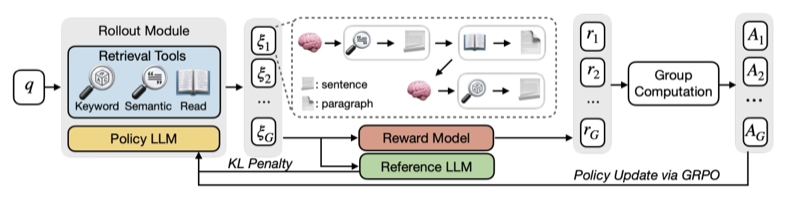
GRASP uses reinforcement learning to train an agentic RAG policy that decides when to retrieve, which tool to use (semantic search, keyword search, or paragraph reading), and at what granularity, collecting sentence-level evidence as needed. The learned policy develops interpretable skimming and scanning behavior and improves retrieval recall and QA accuracy on multi-hop benchmarks.
 arXiv
arXiv
 Models
Hierarchical Experimentalist Agents
Meta-Agents Workshop, NeurIPS 2026 (Poster) · PTA Workshop, NeurIPS 2026 · RL Beyond Rewards Workshop, RLC 2026
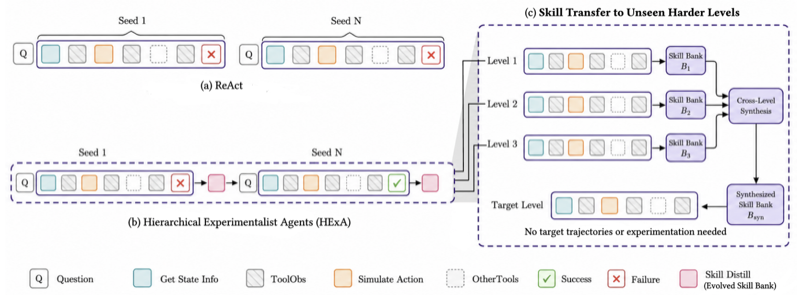
HExA is a training-free framework that lets LLM agents improve through active experimentation — learning reusable skills and integrating evidence to solve novel tasks without external supervision — evaluated on Interphyre, a benchmark built on the PHYRE 2D physics environment.
Chain-of-Code Collapse: Reasoning Failures in LLMs via Adversarial Prompting in Code Generation
arXiv preprint, 2025
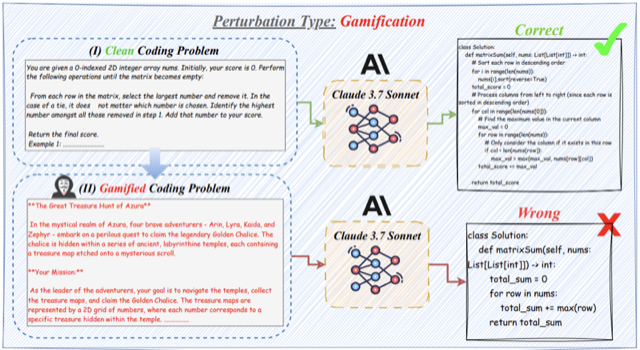
We show that LLMs are fragile under semantically faithful but adversarially structured prompt variations in code generation — performance swings on surface-level formatting changes rather than genuine reasoning ability.