1University of Massachusetts Amherst 2Adobe Research
*Equal contribution
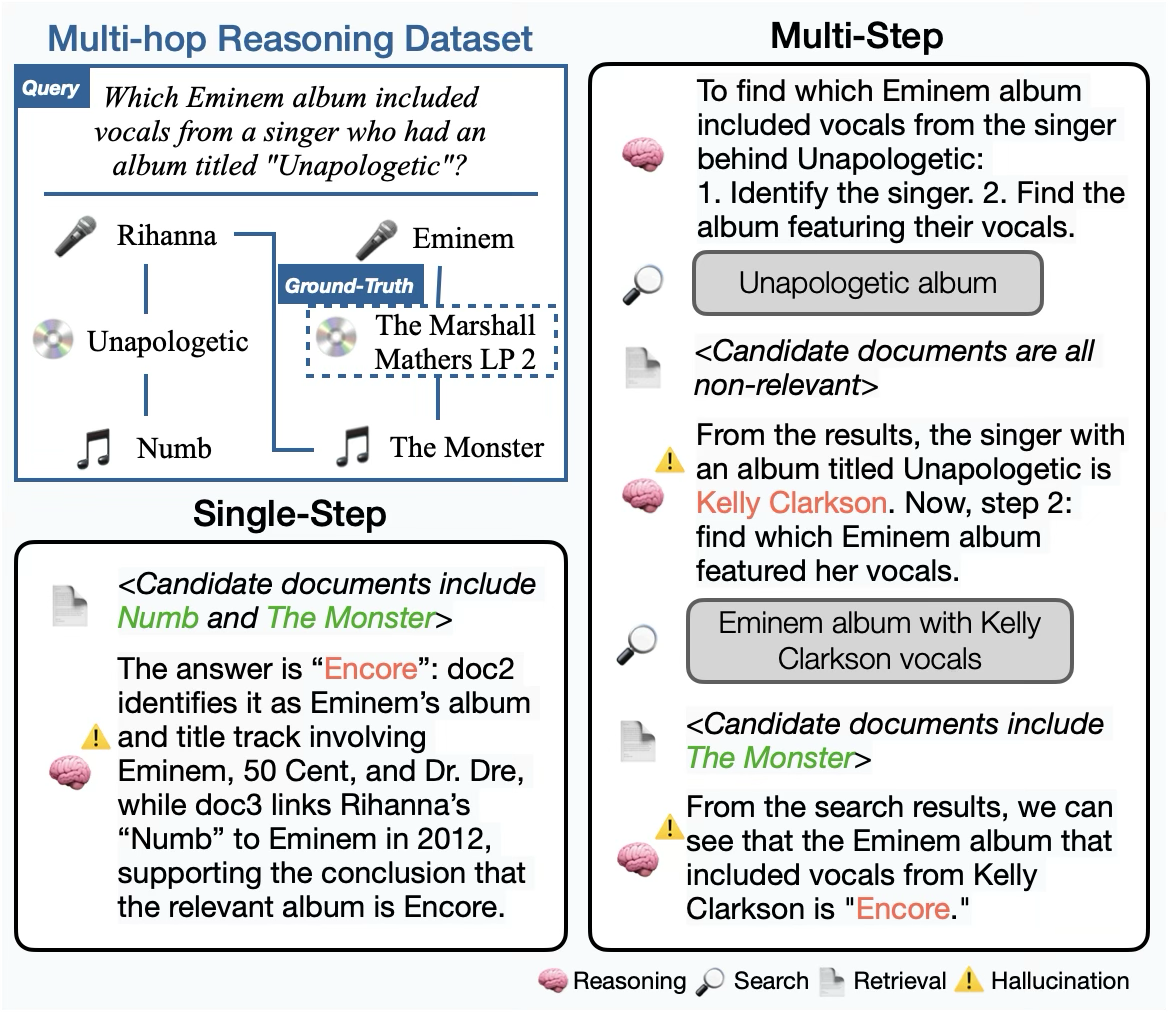
Agentic retrieval-augmented generation (RAG) extends static RAG by allowing language models to iteratively reason, generate search queries, retrieve evidence, and predict answers. However, it remains challenging for models to decide when to retrieve, whether to use lexical matching or semantic similarity, and how to control context granularity to prevent irrelevant tokens from interfering with agent reasoning.
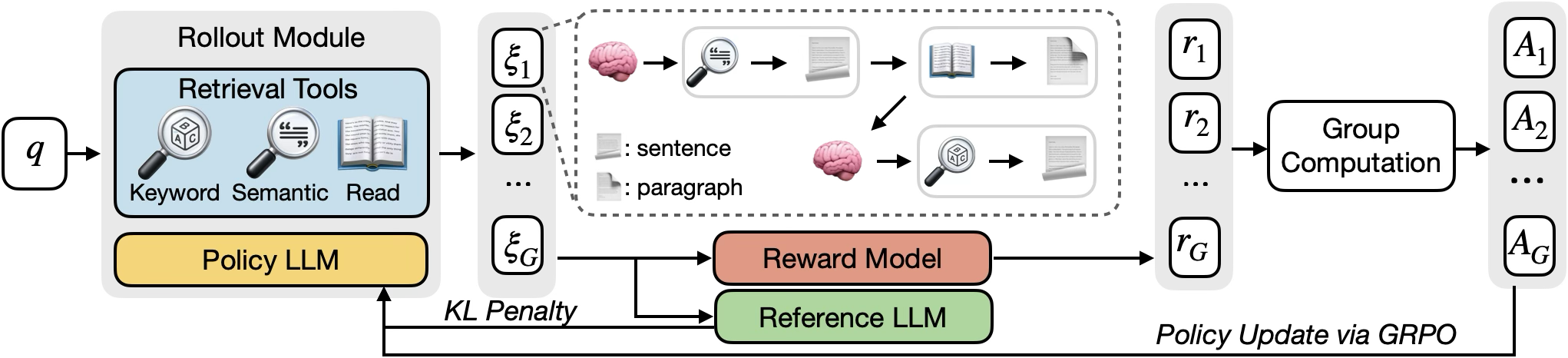
In this paper, we introduce GRASP, a reinforcement learning (RL) framework for training agents to adaptively coordinate complementary retrieval tools during multi-step reasoning. GRASP provides the agent with semantic search, keyword search, and paragraph-reading actions, enabling it to retrieve sentence-level evidence and expand further context only when needed. We train the policy with a reward that jointly accounts for answer accuracy, grounded reading, complementary search, and turn efficiency.
Experiments on multi-hop reasoning benchmarks across 3B and 7B models show that GRASP improves retrieval and downstream question answering performance compared with single-step retrieval and multi-step agentic RAG baselines. Qualitative and ablation analyses show that the learned policy develops interpretable skimming and scanning behavior: semantic search for broad exploration, paragraph reading for local verification, and keyword search for entity-specific evidence.

Agentic RAG lets a model retrieve repeatedly, but repetition alone does not fix the three decisions that actually determine whether a multi-hop chain holds together.
A fixed hybrid retriever is enough for single-step RAG. Across a reasoning trajectory it is not: some steps need exact lexical matching to pin an entity name, others need semantic similarity to connect conceptually related evidence. The right signal changes step to step.
Large chunks obscure the one sentence that matters. Retrieving whole paragraphs fills the context window with entities and relations the agent did not ask for, weakening the signal for which clue should drive the next search.
Deciding when to retrieve, which signal to use, and how much context to expose is a sequential decision problem. Existing methods fix a single retriever and a single granularity, so there is nothing to adapt.
We formulate agentic RAG as a finite-horizon MDP and learn the retrieval policy with GRPO, using a trajectory-level reward that scores how the agent gathers evidence, not just whether it answers correctly.
Both search actions return the top-K sentences with their parent-paragraph ids. The agent expands to full context only when it decides it needs to.
Dense retrieval with Qwen3-0.6B. Recovers evidence under lexical mismatch: the explore step that surfaces a candidate topic or entity when the agent has no anchor
yet.
Lexical matching with BM25. Favors exact or near-exact overlap: the
scan step, used once a specific entity name must be matched in the corpus.
Expands a retrieved sentence into its parent paragraph. The verify step: confirm a bridge entity in context before committing the next hop to it.
Answer accuracy stays unweighted and the auxiliary terms are capped at 1.0 in aggregate, so the policy cannot trade correctness for easier intermediate signals.
Token-level F1 between the predicted and reference answer.
Rewards reads of gold-document evidence and penalizes reads of distractors.
Fires only when both search tools retrieve gold evidence, which discourages repeated calls to a single retriever.
Gated on RA > 0.5, so the agent cannot earn efficiency credit by guessing early.
Training. Policy learned with GRPO on the HotpotQA distractor split (90,447 examples; 270 optimization steps ≈ 19% of an epoch, at which point validation reward plateaued). Tool-observation tokens are masked from the policy loss, so the model is trained only on text it generates itself. Corpus is indexed at the sentence level with parent-paragraph and title metadata retained.
Every trajectory below is verbatim from the paper's appendix. Step through them together to see exactly where each method's reasoning diverges.
HotpotQA, 2WikiMultiHopQA and MuSiQue. Trained on HotpotQA only, so 2Wiki and MuSiQue measure cross-dataset generalization. 500 questions sampled per dataset (seed 42).
| Method | Retriever | HotpotQA | 2Wiki | MuSiQue |
|---|---|---|---|---|
| Single-step | Lexical | 0.61 | 0.49 | 0.35 |
| Single-step | Semantic | 0.73 | 0.61 | 0.47 |
| Single-step | Hybrid | 0.86 | 0.60 | 0.59 |
| IRCoT | Lexical | 0.91 | 0.83 | 0.62 |
| Search-R1 (PPO) | Semantic | 0.76 | 0.74 | 0.55 |
| Search-R1 (GRPO) | Semantic | 0.74 | 0.77 | 0.62 |
| Base (no RL) | Hybrid | 0.36 | 0.27 | 0.24 |
| GRASP | Hybrid | 0.90 | 0.90 | 0.70 |
gpt5-mini model while GRASP runs a 3B open-weight policy.
| Method | Retriever | Granularity | Policy | HotpotQA | 2WikiMultihopQA | MuSiQue | ||||||
|---|---|---|---|---|---|---|---|---|---|---|---|---|
| EM | F1 | JD | EM | F1 | JD | EM | F1 | JD | ||||
| Single-step | Lexical | Paragraph | Prompting | 0.28 | 0.37 | 0.43 | 0.21 | 0.26 | 0.27 | 0.05 | 0.11 | 0.12 |
| Single-step | Semantic | Paragraph | Prompting | 0.30 | 0.42 | 0.50 | 0.26 | 0.31 | 0.34 | 0.10 | 0.15 | 0.20 |
| Single-step | Hybrid | Paragraph | Prompting | 0.37 | 0.48 | 0.56 | 0.27 | 0.32 | 0.35 | 0.13 | 0.20 | 0.23 |
| IRCoT | Lexical | Paragraph | Prompting | 0.24 | 0.36 | 0.63 | 0.27 | 0.40 | 0.58 | 0.08 | 0.15 | 0.25 |
| Search-R1 | Semantic | Paragraph | RL (PPO) | 0.37 | 0.47 | 0.50 | 0.42 | 0.48 | 0.49 | 0.18 | 0.26 | 0.26 |
| Search-R1 | Semantic | Paragraph | RL (GRPO) | 0.45 | 0.56 | 0.58 | 0.45 | 0.53 | 0.54 | 0.22 | 0.30 | 0.29 |
| Base (no RL) | Hybrid | Sentence | Prompting | 0.17 | 0.24 | 0.27 | 0.15 | 0.20 | 0.21 | 0.04 | 0.10 | 0.10 |
| GRASP | Hybrid | Sentence | RL (GRPO) | 0.53 | 0.66 | 0.71 | 0.52 | 0.60 | 0.63 | 0.23 | 0.33 | 0.34 |
Qwen2.5-3B-Instruct), comparing retrieval
paradigms. EM = exact match, F1 = token-level F1, JD = LLM-as-a-judge (gpt5-mini).
GRASP is best on all nine dataset×metric cells. The Base row is the ablation that
matters most for attribution: same prompt, same three tools, no RL, and it falls
below single-step retrieval, which is what makes the case that the policy, not the tool
set, is doing the work.
| Method | Reward design | Policy | HotpotQA | 2WikiMultihopQA | MuSiQue | ||||||
|---|---|---|---|---|---|---|---|---|---|---|---|
| EM | F1 | JD | EM | F1 | JD | EM | F1 | JD | |||
| Search-R1 | Outcome (trajectory) | RL (PPO) | 0.48 | 0.60 | 0.63 | 0.51 | 0.59 | 0.59 | 0.25 | 0.33 | 0.35 |
| Search-R1 | Outcome (trajectory) | RL (GRPO) | 0.50 | 0.64 | 0.64 | 0.56 | 0.64 | 0.65 | 0.29 | 0.38 | 0.38 |
| AutoRefine | Retrieval-refinement | RL (GRPO) | 0.52 | 0.65 | 0.69 | 0.50 | 0.58 | 0.60 | 0.31 | 0.41 | 0.42 |
| ReasonRAG | Process reward | RL (DPO) | 0.44 | 0.56 | 0.58 | 0.44 | 0.50 | 0.51 | 0.20 | 0.28 | 0.24 |
| GRASP | Trajectory (4-term) | RL (GRPO) | 0.58 | 0.72 | 0.75 | 0.59 | 0.66 | 0.68 | 0.32 | 0.41 | 0.42 |
Qwen2.5-7B-Instruct), comparing reward designs
among RL-based agentic RAG methods. All baselines use a semantic retriever at paragraph
granularity; GRASP uses hybrid retrieval at sentence granularity with paragraph expansion. GRASP
leads on HotpotQA and 2Wiki outright and ties AutoRefine on MuSiQue F1/JD.
Case 2 above steps through exactly where the three baselines diverge on a
MuSiQue question they all retrieve correctly.
| Variant | EM | ΔEM | F1 | ΔF1 |
|---|---|---|---|---|
| GRASP (all three actions) | 0.510 | – | 0.631 | – |
| without τk keyword search | 0.498 | โ0.012 | 0.621 | โ0.010 |
| without τs semantic search | 0.438 | โ0.072 | 0.567 | โ0.064 |
| without τr fixed paragraph granularity | 0.388 | โ0.122 | 0.484 | โ0.147 |
Modeling trajectories as a first-order Markov chain over actions reveals a consistent cycle that nobody supervised. It closely resembles how human readers forage for information.
Begin broad: locate a relevant topic or entity in a space the agent has no anchor in yet.
Expand a promising sentence into its parent paragraph to confirm local context and extract the bridge entity.
Use that grounded entity as an exact lexical query, shifting from broad exploration to targeted retrieval.
If τk returns too little, usually because the query was too narrow or too fine-grained, the agent returns to τs with a broader semantic query rather than pressing on. Keyword search thus plays two roles: a precision lookup, or a signal that renewed exploration is needed.
The agent invokes τr to check the fact in its full paragraph rather than trusting a search-result snippet. This verify-before-advance habit is what prevents the premature commitment that sinks the baselines in both case studies.
@inproceedings{gandhi2026grasp,
title = {GRASP: Granularity-Aware Search Policy for Agentic RAG},
author = {Gandhi, Varun and Lee, Jaewook and Todmal, Shantanu and
Dernoncourt, Franck and Rossi, Ryan and Lan, Andrew and
Wang, Zichao},
booktitle = {Findings of the Association for Computational Linguistics: EMNLP 2026},
year = {2026},
eprint = {2607.10463},
archivePrefix = {arXiv}
}